From Arcade we set out with prayer,
then voices scattered like a startled hive:
Where would we meet? Who would take the taxi?
Slowly, our many words found a way together.
At the Berdugo River, I watched the water
flow toward the morning light.
The river travelled downstream;
my heart was being called upstream,
toward the hidden cave,
toward the treasure at its source.
The path answered with a steep climb,
its stones too large to ignore.
Perhaps the journey inward is like this:
we cannot reach the depths
without feeling the weight of the ascent.
Some pilgrims stayed beside a companion who was ill,
giving their time to walk at another’s pace.
Others, carrying difficulties of their own,
kept placing one foot before the other.
Their steps taught me something about courage
and about the grace of accompaniment.
On a wooden wall, we left our names:
Trinis, Lucians, Surinamese and Jamaicans,
beloved pilgrims of September 2026.
For a moment, our small company
joined the long litany of those
who had passed this way before us.
Then came the discarded sofas, beds and cabinets.
Things once welcomed into homes
lay abandoned beside the road.
I thought of José, who had let go of his possessions
to live simply on the Camino.
How tightly I hold what has its season;
how gently the road asks me to release it.
In Pontevedra, waiting stretched the day.
We found no meal at the bar,
so we gathered what we could from a nearby shop
and shared it.
Messages passed between the pilgrims still walking,
the taxi company, and those of us waiting.
Our plans grew tangled again.
At the monastery, I carried one pilgrim
into the chapel with me.
He was still in town, and I feared
he might have to make the long walk to us.
Before the Blessed Sacrament,
I spoke of my helplessness
and asked the Lord to accompany him.
When I opened my eyes, I saw the crucified Jesus:
arms open, body held fast,
eyes lifted toward the Father.
He knew the place where I stood,
with no way to resolve what troubled me.
Out of the depths I cry to you, O Lord.
I let that cry become my prayer.
At dinner, the pilgrim asked us not to feel guilty.
He had given his place in the taxi to another,
and the walk to the monastery
had become a moment of grace for him.
I had prayed for his accompaniment;
he had found it along the road.
Later, as we lingered together after dinner,
another pilgrim joined our conversation.
I wanted the familiar circle back.
My anxiety became anger,
then silence.
When I noticed where my heart had gone,
I returned to the conversation.
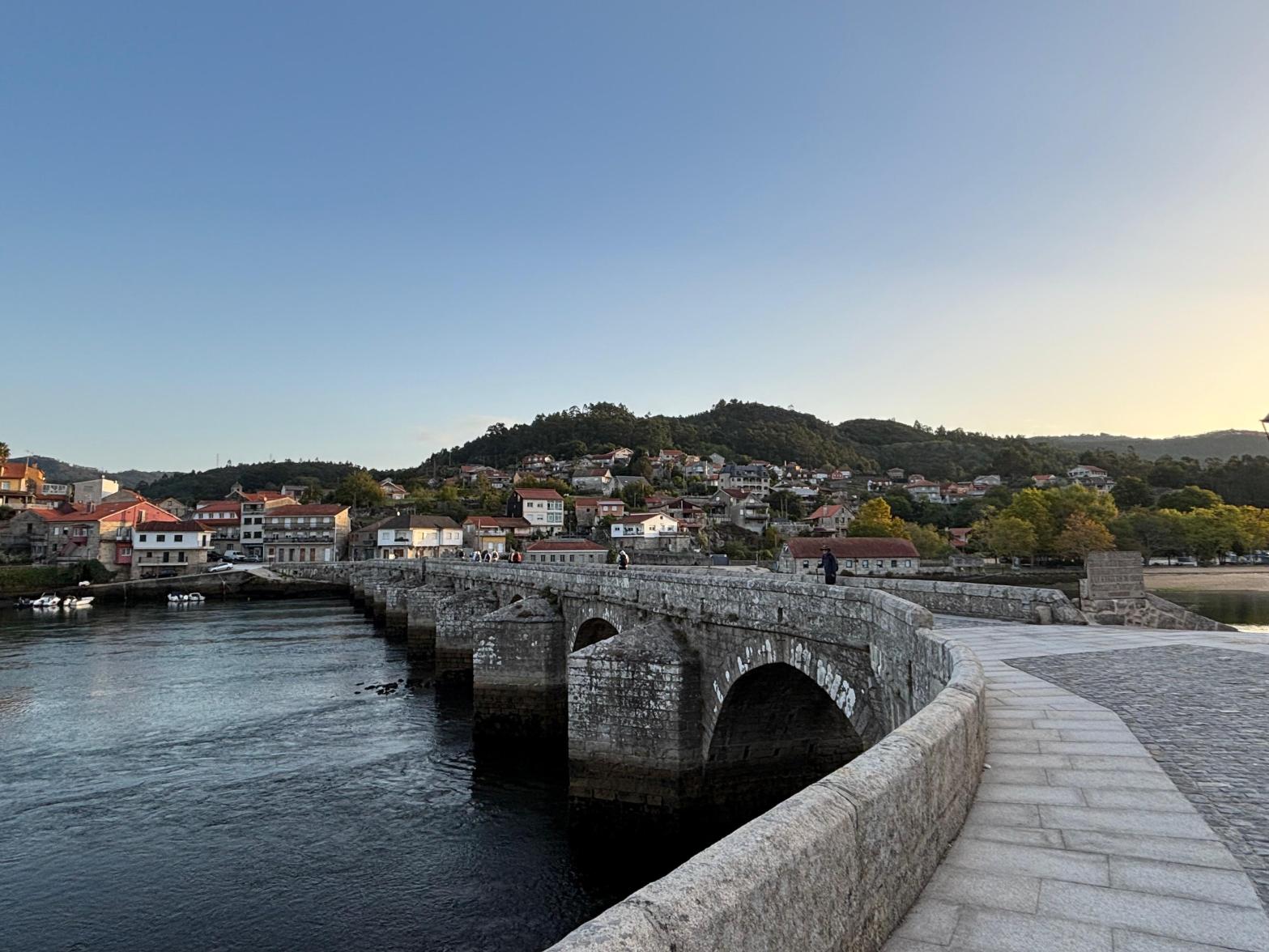
Pontevedra bears the memory of an old bridge.
Perhaps that evening I was asked to cross one more:
from the comfort of our circle
toward the stranger beside us.
The Camino had shown me welcome on the road.
Now it invited me to offer welcome myself.

